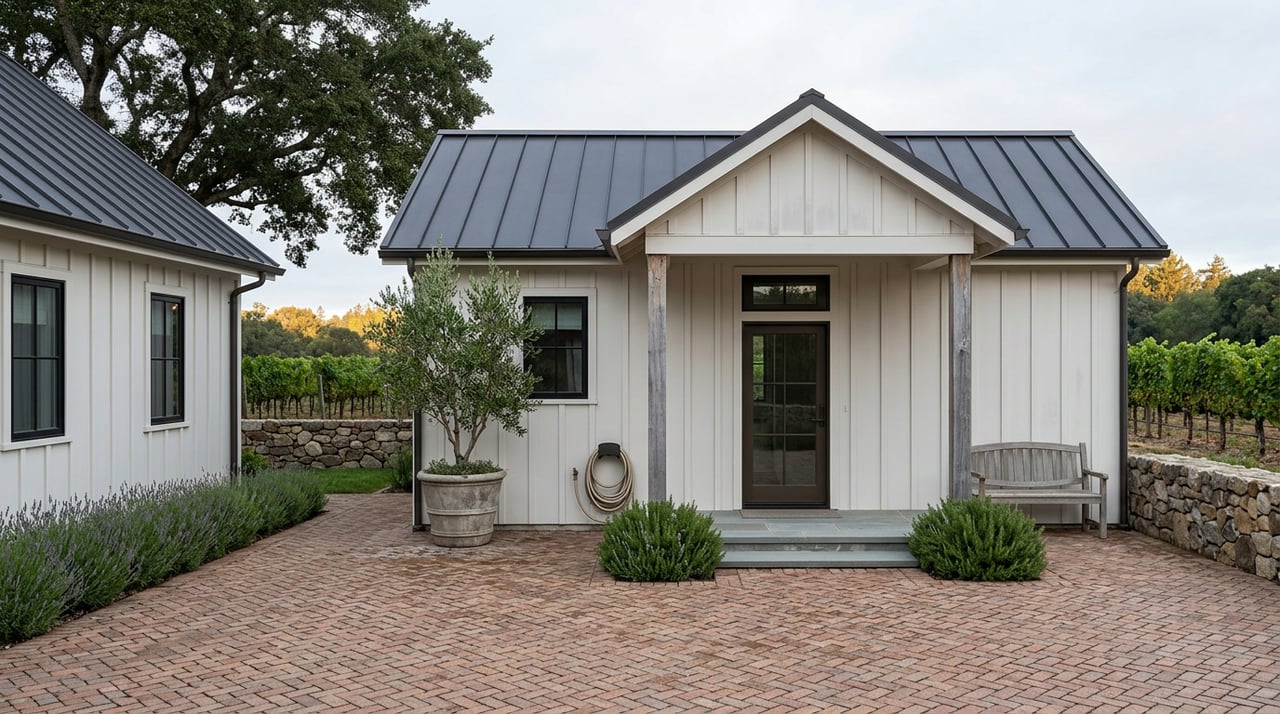
Somewhere in the pitch for almost any Napa Valley property, the phrase "rental income potential" tends to surface. It's a reasonable assumption in a place that fills its inns and vacation homes solid through crush season. In the City of Napa, that assumption holds, up to a point. Buyers there can eventually work their way onto a waitlist for one of a capped number of vacation rental permits. In St. Helena, the door is narrower, but it still opens for a lucky few. Walk into Yountville with the same assumption and it stops working entirely. There is no waitlist to join. There is no legacy permit to inherit. Short-term rental in Yountville isn't scarce. It doesn't exist as a category the town will issue at all.
That distinction is worth sitting with before it shows up in an offer, because it says something about how this particular town governs housing that the rest of the valley doesn't share.
A Permit Elsewhere Is a Scarce Asset. Yountville Has Nothing to Ration.
Look at how the two largest towns nearby handle the same pressure. As of the most recent published tally, from the Napa Valley Register in February 2025, Napa allows short-term rentals through a permit system capped at 41 non-hosted (whole-house) permits and 60 hosted permits, where the owner must live on the property during the rental period. Every one of those permits had been issued at that point, and both waitlists were full, a status the city's own vacation rental page still reflects. St. Helena runs a smaller version of the same idea, capping its program at 25 permitted rentals. One St. Helena homeowner, Carl Dene, told the Napa Valley Register in that same February 2025 report that it took him four years on the waitlist before he could legally rent his two-bedroom home with guest house, a property that books at $1,200 a night whenever it's available.
That's what scarcity looks like when a town decides to ration a resource instead of eliminating it: a fixed number of slots, a queue, and a permit that becomes genuinely valuable to whoever holds it.
Yountville skipped that model. Town Municipal Code Section 8.08.030 sets a 30-day minimum for any rental in town limits. Anything shorter isn't capped, waitlisted, or grandfathered. It's simply not a category the town will register. The Airbnb Help Center states it plainly for hosts trying to list a Yountville property: stays at or under 29 days aren't allowed, full stop.
The Harder the Demand, the Harder the No
Here's what makes that choice notable rather than just restrictive. Yountville is not a sleepy town with no tourist pressure to manage. It's the address most closely associated with the valley's highest-end dining and lodging, a compact stretch along Washington Street that, by its own description, offers "the pinnacle of luxurious living." If any town in Napa Valley had the leverage to run a lucrative capped-permit system the way Napa and St. Helena do, charging premium annual fees for a handful of coveted slots, it would be this one.
Instead, the town went the other direction. Where demand pressure is highest, the policy answer wasn't to create a market for scarce access. It was to close the door on short-term use entirely and push all residential rental activity toward the long-term registration track instead. That's a meaningfully different read on housing than "manage the overflow." It reads as "the overflow isn't ours to monetize."
The ADU Door Doesn't Open Either
As of January 1, 2026, California law gives homeowners more flexibility than ever to add housing on a single-family lot, including the ability to combine a detached accessory dwelling unit, a converted ADU, and a junior ADU on one property under the new statewide framework. For buyers thinking about a guest cottage as an income lever, that's a real opportunity in most of the North Bay.
It isn't one in Yountville. The town's own ADU ordinance, Chapter 17.156, prohibits short-term rental of an accessory dwelling unit or junior accessory dwelling unit for stays under 30 days, no exceptions carved out. The rule predates the 2026 state changes and survives them untouched. A buyer who plans to build a second unit specifically to run nightly stays will find the same wall waiting at the back of the lot that's waiting at the front door.
What's Actually Legal: The Long-Term Registration Track
None of this means a Yountville property can't produce rental income. It means the income has to come from a different kind of tenant.
The town's Rental Property Registration Program, approved by the Town Council on June 6, 2017 and refined the following year, requires every residential rental unit in town, including ADUs, to carry a valid permit before any rent changes hands. A few details matter more than they first appear:
- The permit is valid for one calendar year and must be renewed every January, not on a rolling anniversary tied to when a lease began.
- The permit number has to appear on any advertisement for the unit, which rules out quietly renting off-platform.
- The permit is not transferable to a new owner. Buying a house that's currently a registered long-term rental doesn't hand you the registration. You start the process from zero.
That last point is the one that trips people up. A buyer who assumes a property's existing rental setup carries over with the deed is planning around a permit that legally disappears at closing.
If you're picturing a workaround here, most of the obvious ones have already been closed. This is a town that built its rental rules to be checked before an offer, not discovered after one.
The Same Instinct Is Showing Up at the Mobile Home Parks Right Now
This isn't a one-off rule about vacation rentals. It's a pattern in how the town currently governs housing generally, and it's playing out in a completely different part of Yountville this year.
In August 2026, the Yountville Town Council took up whether to cap rent increases at the town's two mobile home parks, Bella Vista Mobile Home Park and Rancho de Napa, home to residents who own their manufactured homes outright but rent the land beneath them. The council didn't adopt anything. It sent the question back to staff for more data and stakeholder meetings, as Hoodline reported, citing the Napa Valley Register's coverage of the meeting. Resident Robert Oakes told the council rent stabilization could let longtime seniors stay in homes they already own without stripping park owners of their rights entirely.
The stakes are specific to this town. A 2022 filing the town submitted to the state housing department shows residents 55 and older make up nearly two-thirds of Yountville's population, and town zoning reserves 80 percent of the units at both parks for seniors. Rancho de Napa alone holds 235 spaces, and the combined 299 units represent, per that same filing, close to the only unsubsidized path to homeownership left in a town this small.
No ordinance passed yet. But the direction of the debate looks familiar. Faced with a housing-cost pressure point, the council's instinct was to slow down and protect the people already living there rather than move quickly toward a more flexible, market-driven outcome. That's the same posture that shows up in the short-term rental ban. Buyers hoping the STR rule is an outdated quirk likely to loosen with the next council cycle are reading against the town's current grain, not with it.
What This Means Before You Write an Offer
If a Napa Valley purchase in Yountville needs to pencil out on rental income, price it against a 30-day-or-longer lease, not a nightly rate. Before assuming any income at all, a few things are worth confirming directly with the Town of Yountville Planning and Building Department:
- Whether the property currently holds a valid long-term rental registration, and whether it will need to be reapplied for after closing (it will).
- Whether any ADU or JADU on the property carries a recorded restriction limiting rental term, which is standard in Yountville regardless of when the unit was built.
- Whether your actual goal, occasional short-term hosting, is better served by looking at a property in the City of Napa or St. Helena, where a capped but real permit system exists, rather than assuming Yountville rules will bend to accommodate it.
None of this makes Yountville a weaker purchase. It makes it a different kind of purchase, one built around long-term value, personal use, and the town's own character rather than a hospitality business model borrowed from elsewhere in the valley.
FAQ
Can I rent a single spare room in my Yountville home to a guest for a weekend? No. The 30-day minimum applies to any rental under that threshold, whether it's a whole house or a single room, hosted or not.
What if the home I'm buying already has a history of short-term rentals? That history doesn't transfer with the sale. Yountville's rental permits are explicitly non-transferable between landlords, so a new owner starts the registration process from the beginning regardless of what the previous owner did.
Does this mean the property can't generate any rental income? Long-term leasing of 30 days or more is legal with an annual town registration. It's a different income model than nightly stays, closer to a traditional lease than a hospitality business, but it is a real option.
Understanding a town's actual posture toward housing, not just its zoning map, is part of what makes an offer in Napa Valley hold up under scrutiny. If you're weighing a Yountville property against options in Napa, St. Helena, or elsewhere in the valley and want to know exactly what a specific address allows before you write a number, Carolyn Roberts has spent decades in these towns and can walk you through it directly. Let's Connect.